


At a Glance
- Institutional investment portfolios have grown increasingly complicated, adding new asset classes, strategies, geographies, and structures, driving allocators to explore ways to better navigate this complexity.
- Total Portfolio Approach (TPA) is one approach to this growing complexity, and it has generated a great deal of interest from institutional investors. TPA argues that investors can achieve better outcomes by focusing on the portfolio-as-a-whole rather than on asset-class silos.
- TPA has attracted some real debate. Proponents view it as a means to better align capital allocation with total-fund objectives, while critics argue it can weaken governance guardrails and increase institutional risk.
- We believe a thoughtful application of the concepts underpinning TPA can improve portfolio outcomes while preserving essential guardrails. Such an application should not require a wholesale change to an organization’s goals and capabilities.
- We introduce the “Complications Framework,” a practical tool that applies total-portfolio insights to help investors evaluate asset classes, managers, and investments by weighing portfolio-level benefits against costs and frictions.
Introduction
Over the past few decades, institutional investment portfolios have grown increasingly complicated, adding new asset classes, strategies, geographies, and structures—what we call “complications.” As a result, portfolios have become more difficult to navigate, with meaningful costs and frictions arising. We hear about this problem often from our institutional investor clients, and studies show that the costs and frictions of these growing complications may lead investors to underperform even basic passive benchmarks.1,2,3 This is the problem that Total Portfolio Approach (TPA) is meant to solve.
What is a Total Portfolio Approach (TPA)
The Total Portfolio Approach (TPA) is an investment framework that evaluates all assets collectively, optimizing the portfolio as a whole rather than managing asset classes in isolation. It emphasizes integrated decision-making across risk, return, and liquidity to maximize overall portfolio efficiency and align investments with long-term objectives.
At its core, TPA aims to reframe how investment decisions are evaluated. Rather than organizing portfolios primarily around asset-class silos, TPA emphasizes the contribution of each decision—each new asset class, manager, and investment—to overall portfolio objectives, such as long-term wealth creation, risk tolerance, liquidity needs, and resilience across economic regimes.
Proponents argue that TPA improves the quality of investment decisions by enabling investment teams to view their decisions holistically. Critics counter that asset-class silos exist for a reason: to impose discipline and accountability. If these silos are removed in the absence of the technology, governance structures, and analytical tools needed to understand total-portfolio performance, TPA risks exacerbating the very complicatedness that it seeks to address: the accumulation of layered structures, constraints, and frictions inherent in real-world portfolios
We believe TPA framing can be used effectively within existing organizational structures without necessarily increasing the risks that critics fear. Our proposed type of TPA focuses on generating more transparent insights into the trade-offs, interactions, and cumulative effects of portfolio complications, enabling CIOs and their teams to make better decisions without removing guardrails or undergoing wholesale organizational transformation.
A New Framework for Portfolio Design
The challenges of portfolio complication are not new. Over time, institutional investors have developed a range of portfolio models to cope with these pressures, each focusing on specific dimensions of complication while deliberately abstracting away others. These models are best understood as stylized archetypes—most investors blend elements of several approaches rather than adhering to any single model in a rigid way—but they help clarify the underlying trade-offs.
For example, the Endowment Model4 prioritizes higher returns through significant allocations to private assets managed by third parties while accepting reduced transparency into portfolio interactions. It is perhaps the clearest example of asset-class siloing. By contrast, the Canadian Model5 emphasizes direct investing and in-house teams, accepting the need for larger and more costly governance structures to enable decision-making across silos.
Our observation is that more broadly, models such as these—alongside the Sovereign, Dutch, Norwegian, and Insurance approaches—have enabled institutions to scale by either reducing the dimensionality of the investment problem (deciding which complications to actively manage and which to ignore) or by adding governance layers.

Figure 1: Models as Simplification Devices
While these models have helped to make the complication problem tractable, they have also imposed structure that can produce real-world negative consequences. For example, the hard siloing of the archetypal Endowment Model can make it difficult for investors to measure and manage their exposures at the total-portfolio level to sectors, geographies, and economic factors. The Norwegian Model, in its archetypal form, eschews private asset classes precisely because of this challenge but, as a result, loses the ability to gain from private asset classes.
Beyond just the costs of these dimension-reduction decisions, these models have increasingly been applied outside of the environments for which they were designed. Where these models have worked, they have done so in large part because governance, incentives, scale, and capabilities were built together and with the goals and characteristics of a specific limited partner (LP) in mind. For example, the Canadian Model6 has worked for LPs with the large scale necessary to support its direct investments and heavy governance layer. The Norwegian Model has worked for investors whose goals can be achieved without the benefits of private asset classes. However, as different investors adopted these standardized models and added asset classes for which they were not designed, the models increasingly became ill-fitting. Investors have found that assets with distinct cash-flow profiles, risk drivers, and implementation challenges cannot all be effectively managed under identical frameworks. Transplanting the structures without fitting them to individual goals and building the supporting machinery can create more problems than it solves.
TPA is valuable in this context not because it necessarily offers a superior replacement model, but because it helps make visible the trade-offs inherent in adding more asset classes, managers, investments, and governance structures—the complications. It provides a language for understanding what existing models simplify, what they obscure, and where their assumptions strain as portfolios evolve. Even if TPA itself is just a platonic ideal, its lessons can still be useful.
The Complications Framework
In our view, much of the confusion around TPA stems from treating total-portfolio analysis—a way of framing questions, trade-offs, and interactions—as inseparable from total-portfolio governance—a specific operating model that centralizes decision authority and de-emphasizes asset classes. The two are related, but they need not move together. Separating them helps explain why total-portfolio insights can be valuable even when full organizational adoption is neither feasible nor desirable.
This is where the Complications Framework comes in. By complications, we mean any portfolio decision that increases the dimensionality of the investment problem. We are confident that each complication is always added in search of potential benefits (e.g., returns, diversification, resilience, flexibility). However, complications necessarily also introduce costs (e.g., internal resources, fees, governance burden) and frictions (e.g., liquidity strain, pacing drag, delayed rebalancing).
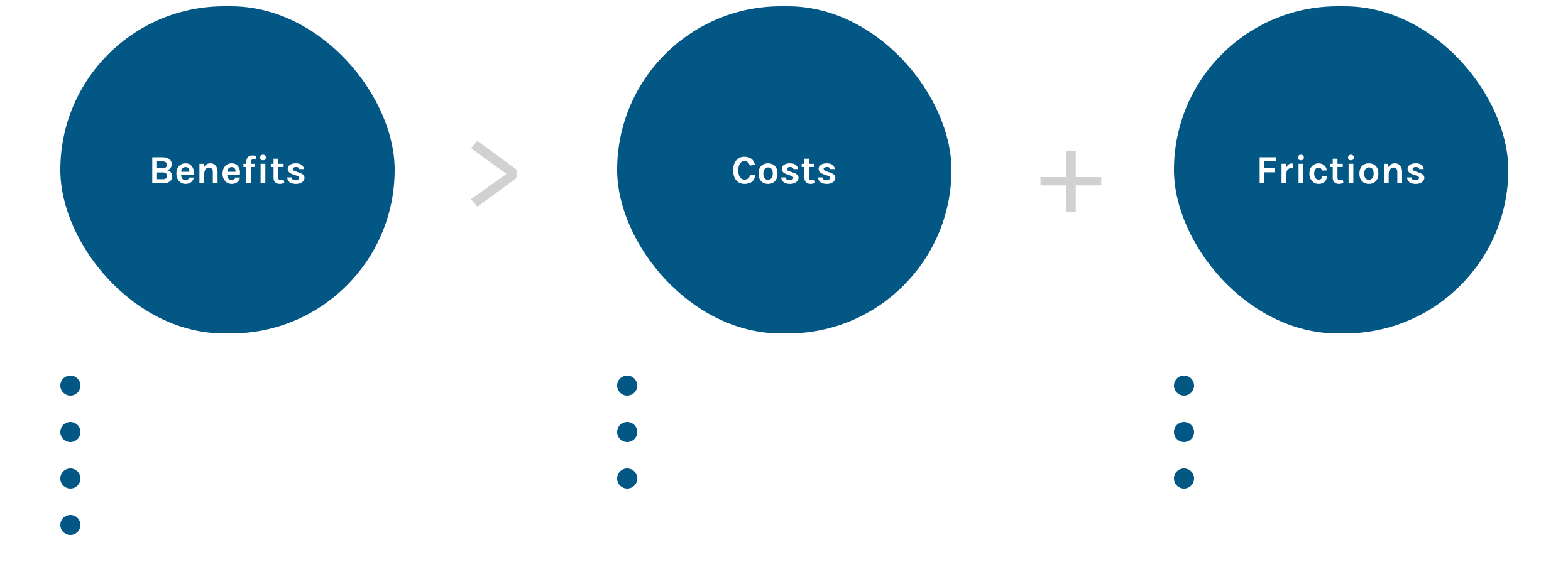
Figure 2: The Complications Framework
Complications are not inherently negative; as just explained, they are always introduced in search of improved portfolio outcomes. However, they should earn their place in the portfolio, and once introduced, they should be actively managed to ensure their benefits exceed their costs and frictions. The challenge is that their costs are rarely explicit, and their interactions are difficult to observe within traditional asset-class frameworks. Addressing this challenge then becomes the key focus.
The TPA Spectrum
With the Complications Framework as a backdrop, we believe different investors can leverage TPA in ways that best suit their organizations, goals, and capabilities. Many, and likely most, investors will not be able to move away from the traditional models; these investors start at the brown box in Figure 3 below (lower left quadrant). Even for these investors, however, we argue that total-portfolio thinking can bring meaningful advantages (blue box, upper left quadrant) by helping investors to better see the trade-offs they are making—without removing guardrails. These investors can keep their traditional asset-class silos, but better account for the interactions between asset classes, the factor exposures and alpha sources they achieve from each, and still consider the impact that an investment in one asset class has on others. Some investors—perhaps a growing number over time—will find they can benefit further by moving toward reference portfolios, shared risk budgets, and more flexible decision-making—toward the TPA platonic ideal (green box, upper right quadrant)—though only as technology, analytics, and governance allow. Adopting full TPA without these capabilities (gray box) is what critics rightly fear.
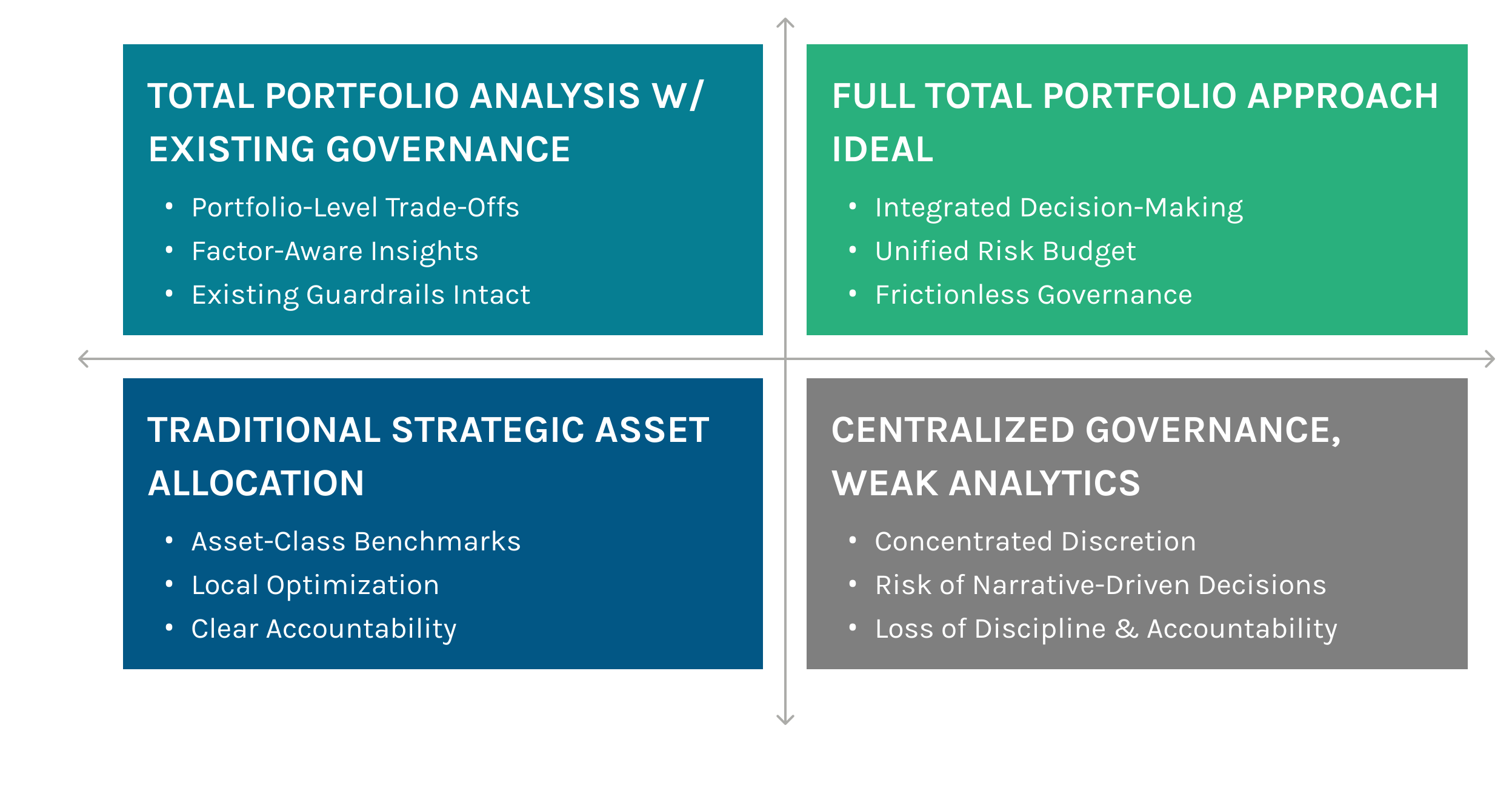
Figure 3: Total Portfolio Governance vs. Total Portfolio Analytics
This range (or grid) matters because it clarifies what TPA does—and does not—imply in practice.
Case Study: Adding a New Private Asset Sleeve
Consider an investor evaluating whether to add a new private-market sleeve, whether defined by asset class, geography, or sub-strategy. Viewed through a traditional asset-class lens, the decision might focus on expected returns, long-run diversification assumptions, and the allocation decisions of peers.
A total-portfolio framing using our Complications Framework expands the decision set by forcing a broader set of questions to be considered jointly:
Benefits
- Goals: What problems is the asset class coming to solve? How will it solve them?
- Factor exposures: What underlying risk factors does the new sleeve introduce, and how different are they from those already embedded in the portfolio
- Alpha potential: How differentiated is the opportunity set, and how difficult is it to access persistent alpha
- Liquidity: Will the asset class help to better achieve the portfolio’s liquidity goals?
- Low observed volatility: Is the low observed volatility of private assets a benefit? Will it provide more discipline during downturns?
Costs
- Internal and external direct costs: Will the benefits of the asset class outweigh the fees to the managers and the internal costs of a dedicated asset-class team (assuming one is required)?
Frictions
- Intra-asset diversification: How much diversification is needed within the sleeve to manage concentration risk, and what does that imply for the number of managers, commitments, and governance complexity?
- Liquidity and rebalancing: Will the asset class make liquidity management more difficult? How can this difficulty be mitigated? What costs might the asset class generate when and if it makes rebalancing more difficult?
- Opacity: Will the asset class make it more difficult to measure and manage the overall portfolio’s exposures? What are the risks of increased tracking error vs. benchmarks or opacity in investments?
Overarching Question
- What do you need to believe: What are the beliefs about the particular strategy, manager, and macro environment that need to be true for this sleeve or strategy to be additive relative to the reference portfolio or alternative use of risk budget?
Individually, none of these questions are new. The value of total-portfolio analysis is that it forces them to be addressed together, in terms of their contribution to total-portfolio outcomes rather than in isolation. In some cases, this framing may support adding the complication. In others, it may suggest that similar exposures can be achieved more efficiently through different structures, sizing, or pacing—or that the incremental complexity is not justified.
This example shows that total-portfolio insights do not replace judgment or governance. Instead, they improve the quality of the questions being asked and make the trade-offs more explicit, helping investors decide not only whether to accept additional complicatedness, but how to manage it more deliberately once it is part of the portfolio.
Progress Through Technology
Traditional committees, governance processes, and data systems can only accommodate a limited number of dimensions and interactions. As a result, the dimension-reduction and governance layers of existing models have not merely been a preference, but a necessity. Today, advances in data, analytics, software, and quantitative tools are beginning to shift this frontier. They do not eliminate uncertainty, nor do they remove the need for judgment and governance. However, they do expand the set of questions that can be explored in a disciplined way before capital is committed.
In the context of total-portfolio analysis and the Complications Framework, these tools can help investors in multiple ways: integrating public and private assets within a common analytical framework; translating asset-level performance metrics into portfolio-relevant measures such as time-weighted returns and wealth creation, model cash-flow dynamics, pacing, and reinvestment assumptions; exploring concentration, liquidity, and factor interactions across assets and strategies; and stress-testing how different structural choices affect portfolio outcomes over time. For example, at Ares we have been experimenting with and deploying new models for understanding the factor exposures of private asset classes, translating IRRs into time-weighted returns, and predicting private-market valuations and cashflows.
The value of these capabilities is not in producing precise forecasts or identifying an optimal portfolio. Rather, it lies in improving clarity around trade-offs and enabling more informed discussion of risks, constraints, and consequences. Clearer framing and better tools are complementary: framing defines what matters, and technology helps make those dimensions visible.
Used thoughtfully, these advances allow investors to manage greater dimensionality without abandoning the guardrails that make portfolios governable. They support more deliberate choices about where complexity is worth accepting and where simplification remains the better course.
Charting a Clear Path to Progress
We believe the most relevant question for investors is not whether to “become a TPA manager,” but how to use total-portfolio insights to operate more effectively within real-world governance constraints. TPA can be a practical tool for improving clarity around trade-offs that are otherwise implicit or obscured. It can help investors identify where portfolio complexity is creating hidden costs, where structural choices no longer fit the assets they are meant to govern, and where the cumulative effects of incremental decisions may outweigh their intended benefits.
Most investors operate in a non-ideal world, shaped by legacy structures, governance constraints, and practical limits. TPA brings to the surface the real challenges facing institutional investors—growing complexity, opaque risks, and interactions that are difficult to understand within traditional frameworks—while managing portfolios in a way that improves net outcomes. The solution does not necessarily require abandoning existing structures. It requires clearer thinking, better tools, and a willingness to examine how incremental decisions interact at the portfolio level.
That is where most investors live—and where we believe meaningful progress can be made.